
What Pages Should a Website Actually Have?

Most business owners treat their website like a digital brochure. They throw up a Home page, a generic About section, and a contact form, then wonder why the phone isn't ringing.
In reality, your website shouldn't just exist; it should work. Like a well-oiled machine, every page should have a specific job to do. If you’re ready to stop guessing and start building a site that converts, here is the essential blueprint.
1. The Home Page: It’s Not About You
Your Home page is your digital calling card, but here is the hard truth: Your customers don't care about you yet. They care about their problems.
A high-converting Home page follows a specific flow:
The Hook: Identify the customer's problem immediately. Make them say, "Yes, I have that! Tell me more."
The Solution: Showcase how you solve that problem and why you’re different from the competition.
Social Proof: Weave in testimonials and success stories.
The CTA: A clear Call to Action. Whether it's a "Free Estimate" or a "Discovery Call," tell them exactly what to do next.
2. Service-Specific Pages (Your SEO Secret Weapon)
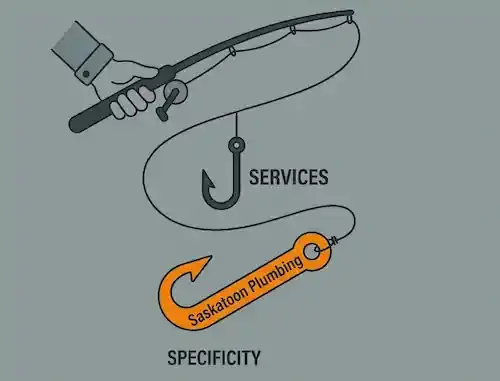
Don't just list your services as bullet points on one page. Give each service its own page. If someone in Saskatoon is searching for "emergency furnace repair," a dedicated page on that topic will always outrank a generic list. Use these pages to tackle specific problems. Ask yourself: "What do I do that makes money, but customers don't know about?" Attack that problem directly on its own page.
3. The About Page: Turning Cons into Pros
The About page is often the second most visited page on a site because people want to know who they are supporting. Don't write a dry resume. Instead, use your history to build trust.
This is the place to turn perceived weaknesses into strengths. Maybe your prices are higher than big-box stores? Frame it as an investment in a staff with X years of experience who will steer the customer in the right direction the first time.
4. Location Pages: The Snowball Strategy
If you serve a specific radius (like Saskatoon, Warman, and Martensville), you need dedicated Service Area pages.
Don't just swap out the town name. Create unique content for each area. This is a ninja move for breaking into markets where there is little competition. A testimonial from a neighbour in a small town carries significantly more weight than a generic review from a stranger in the city.

5. The No-Fluff Portfolio and FAQ
For non-visual businesses, don't rely on generic stock photos.
Portfolio: Focus on the result. Show the "frustrated, scared business owner" before and the "happy, smiling person" after your services.
FAQ: Use this to kill objections politely. If people think you're too expensive, use the Ice Cream Shop analogy. Explain why your ingredients (quality of work) are better than the fast food joint down the street whose machine is always broken.

6. The Blog: Education Over Ego
A blog shouldn't be an online diary of your Employee of the Month. It should be a resource. Answer your customers' most common questions in a long-form format. By providing helpful expertise for free, you build Top of Mind awareness so that when they finally need a pro, you’re the only person they call.
7. The Contact & Thank You Duo
Your Contact page should qualify leads. Don’t be afraid to ask about budget ranges or timelines—it saves you from tire-kickers. Most importantly, set expectations with a "What Happens Next" section.
Once they hit send, don't just show a Message Sent pop-up. Use a Thank You Page to keep the momentum going. Offer a free guide, a special offer, or links to other helpful parts of your site. They already like your vibe—don't let the conversation end there!
Ready to build a website that actually works?
At KARR Video Productions, I don't do fluff. I build powerful, service-driven websites for businesses that want results.
Find out more about my Website in a Week and let's get your digital real estate working for you.


Comments